28 Jul 2026
How do newspapers represent protest? Which social movements, political parties, and civil society organisations receive the greatest media attention? Which issues dominate public debate? And how do news media shape public perceptions of protest as a form of democratic participation?
These are the questions addressed by the new deliverable “Protest Event Analysis (PEA) and Frame Analysis of Political Participation”, produced within the Horizon Europe project INTERFACED – Interfaces for Democratic Participation: Deliberation, Mobilization and Contestation Since the Onset of the Covid-19 Pandemic.
The deliverable was realized by the University of Parma research team, led by professor Lorenzo Mosca, and represents one of the main outputs of the project’s Work Package on news media and political participation.
The study examined more than 83,000 newspaper articles published between 2020 and 2025 in 14 newspapers across Italy, the United Kingdom, Hungary, Romania, and Tunisia. The resulting dataset includes nearly 9,500 reconstructed protest events and more than 16,000 articles analysed through a dedicated frame analysis.
A key contribution of the project lies in its methodological innovation. The research team developed a novel computational workflow combining Large Language Models (LLMs), Natural Language Processing techniques, and extensive human validation procedures. This approach makes it possible to identify, classify, and compare protest events across multiple languages and media systems while maintaining high standards of methodological transparency and reliability.
Compared with traditional Protest Event Analysis, the project introduces several methodological advances, including original procedures for event deduplication and event fusion, allowing researchers to reconstruct unique protest events reported by multiple newspapers. It also integrates event-level analysis with media frame analysis, making it possible to investigate not only which protests receive media attention but also how they are represented.
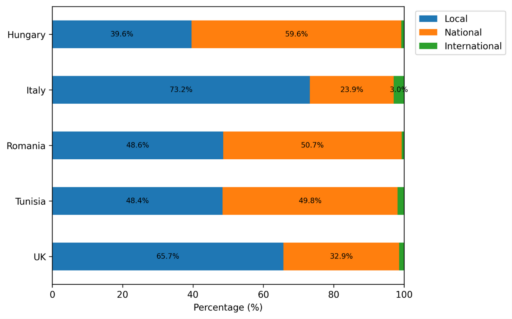
One of the most interesting findings concerns the geographical scale of protest. Contrary to the common assumption that major national newspapers primarily report large demonstrations in capital cities, the study shows that a substantial share of the protest events covered consists of local protests. This suggests that, even through national media, citizens are frequently exposed to conflicts rooted in local communities, involving labour disputes, public services, environmental issues, and place-based mobilisations, highlighting the continuing importance of the local dimension of contemporary political participation.
Distribution of Protest Events by Territorial Level and Country
Furthermore, contrary to the widespread perception that contemporary protest is dominated by single issues, the study reveals a remarkably diverse protest landscape. Labour-related mobilisations coexist with environmental and climate campaigns, civil rights initiatives, democratic claims, cost-of-living protests, and demonstrations related to international conflicts, pointing to a protest agenda that is far broader and more diversified than public debate often suggests. At the same time, important cross-national differences emerge, reflecting the distinct political, economic, and institutional characteristics of national contexts. The analysis also highlights significant changes over time, with some issues gradually losing prominence after the pandemic while others have become increasingly central, confirming the dynamic and constantly evolving nature of contemporary political participation.
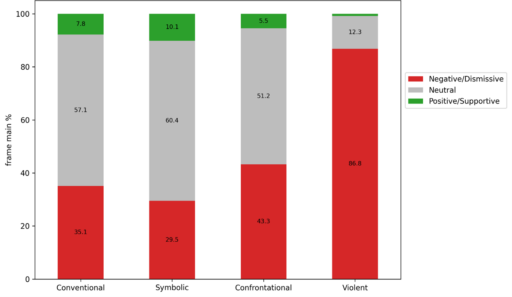
On the other hand, not all protest issues are portrayed in the same way by the media – and particularly by the newspapers examined in this study. Labour-related and welfare-related mobilisations tend to receive predominantly neutral and descriptive coverage, whereas protests connected with geopolitical, identity-related, or more politically polarized issues are considerably more likely to be represented in negative terms. The findings demonstrate that there is no single way in which protest is reported: the tone of media coverage varies substantially according to both the claims advanced by protesters and the forms of action they adopt. More confrontational protests continue to receive coverage that is more strongly oriented towards public order and security concerns, whereas labour and broader socio-economic mobilisations tend to be portrayed in a more descriptive and contextualized manner. The analysis also shows that media evaluations depend more on the form of protest than on the size of the mobilisation. Coverage becomes significantly more negative when protests involve violent or highly confrontational forms of action, whereas symbolic and conventional protests are much more likely to receive neutral or even favorable coverage. Overall, the findings reinforce the idea that news media do not merely report protest but actively contribute to shaping its public visibility and political meaning.
Media Framing by Protest Repertoire
The analysis also shows that, in most newspaper articles, considerably more space is devoted to opponents of protest than to its supporters. This asymmetry suggests that public debate tends to focus more on criticism of protest and its perceived consequences than on the motivations and claims put forward by those who take part in collective action.
These findings represent an important milestone of the INTERFACED project and provide new insights into how contemporary protest is portrayed by the news media and how such representations contribute to shaping public debate in contemporary democracies.
Read the original article in Italian on the University of Parma website: https://www.unipr.it/notizie/proteste-media-e-intelligenza-artificiale-dalluniversita-di-parma-uno-studio-comparativo


Copyrights © 2026 | INTERFACED Cookie & Privacy Policy - University of Parma Leads AI Study on Protests, Media and Political Participation in Europe Webdesign & Development by ALYS