17 Apr 2026
In the last five years, Tunisia has undergone a dramatic political transformation. Once the cradle of the Arab Spring, the emergency measures taken by President Kais Saied in July 2021 have been followed by a slew of legal and judicial measures that have severely restricted public life. Institutions that once facilitated participation and pluralism have been weakened, reconfigured, or hollowed out, narrowing the channels through which Tunisians can formally engage in public life (Weilandt, 2025; Sadiki and Saleh, 2024; Ridge, 2022).
One of the clearest indicators of this contraction is the sharp decline in voter turnout. In 2014, voter turnout stood at 67% in parliamentary elections and 63% in the presidential race. It fell to just 11% in the 2022 parliamentary elections (International Parliamentary Union, 2022). Beyond the ballot box, civil society organisations—long a pillar of post-revolution civic life—have faced mounting restrictions, police harassment, and an increasingly intimidating climate for dissent. Together, these trends point to a steady erosion of formal political participation in Tunisia’s new political system.
So, have Tunisians stopped participating? More broadly, how does political participation change when a system shifts from (a transitional) democracy to authoritarianism? In such conditions, participation may decline but it may also shift —in form, visibility, and meaning. Some of the literature argues that in authoritarian regimes, participation is often redirected into state-controlled channels (Gandhi, 2008; Magaloni, 2006). However, the low voter turnout and very low rates of participation in pro-government protests in Tunisia suggest that participation is not taking place through state-controlled channels. Nor has it disappeared. Instead, we appear to be seeing a reconfiguration of participation.
Here, we can highlight two key trends in this reconfiguration of political participation since 2021. The first concerns the non-linear protest dynamics under authoritarianization. The best available systematic data on protest activity in Tunisia comes from the Tunisian Forum on Economic and Social Rights (FTDES) Observatory, which tracks “social movements” (including protests, strikes, sit-ins, etc.). The data shows an initial dip in street-based contentious action (protests, strikes, etc.) after Kais Saied’s power grab in July 2021. This may be due to the effects of repression as well as fragmentation among social and political actors. The data shows that early 2024 witnessed the lowest ever number of protests since the uprising in 2011. However, this was followed by a sharp resurgence in 2025, representing an increase of over 80% on 2024 (4800-5000 total protest events in 2025). The year 2025 saw a steady rise in protest events, with a peak in October 2025 (545 protest events). January 2026 data suggests this upsurge is ongoing (FTDES, 2026).
Table 1: Evolution in protest events, 2021-25 (FTDES, 2021, 2022, 2023, 2024, 2025)
| Period | Protest trend | Approximate level |
| 2021–2022 | Decline / fragmentation | Moderate → lower |
| 2023 | Weak recovery | Still relatively low |
| 2024 | Lowest point | ~2,600 annually (est.) |
| 2025 | Sharp surge | ~4,800–5,000 |
| 2026 (early) | Continued increase | Rising further |
Thus, protests have remained a key avenue for voicing demands around a whole set of issues despite increasing authoritarianism. The number one theme for protests captured by the FTDES was civil and political rights (support for individuals, opposition to judicial decisions, demands for the release of political detainees, denunciation of political positions, violations of citizen rights, and the right to freedom of expression), followed by professional and labor-related mobilizations, and environmental demands (the right to clean air, the right to life, and a healthy environment, access to drinking water, etc.).
Notably, these protests use unambiguously political framing rather than adapting to the repressive environment by adopting more ambiguous framing. A case in point is the environmental protest movement in the southern city of Gabes (Djerbi, 2025; Amara, 2025). The Gabes protest movement emerged in response to local concerns over the environmental and health effects of the state-owned Tunisian Chemical Group (CGT) phosphate plant in the city. For decades, the complex has emitted toxic gases and dumped chemical waste (including phosphogypsum) into the sea and environment, causing the collapse of the marine ecosystem, severe air pollution, and contamination of soil and water. The city reports particularly high rates of cancer, respiratory disease, infertility, and bone illness, while acute incidents (e.g., gas leaks) have caused mass hospitalisations (Addezio, 2026; Djerbi, 2025; Jaballah, 2026; Ben Hamadi, 2025).
While the Gabes protest movement stretches back over a decade, the fall of 2025 saw a rise in protest activity after the hospitalisation of over 180 people starting in September 2025 (Jaballah, 2026). A large demonstration in October 2025 drew over 50,000 protesters (in a city of around 160,000). Protest slogans centred on the right to life, health, and a clean environment, as well as broader demands for territorial justice and a new regional development model. The protest movement is led by a citizen collective (Stop Pollution-Gabes) that brings together local environmental groups, unions and civil society, and participation spans ordinary residents, youth, and affected economic groups (such as fishermen and informal sector workers) (Jaballah, 2026). High levels of support for the movement’s demands are reflected in the large protests that have persisted over recent years despite heavy repression, including the imprisonment of movement activists (ICJ, 2025).
The Gabes movement organises itself around a shared frame of diagnosis (structural pollution as a fundamental problem that can be attributed to the state and the chemical industry) and demands (around environmental justice and reform to the industrial model of development). This convergence of diagnosis, attribution, and prognosis yields a coherent mobilising discourse that is consistent with framing theory. Like the revolutionary chain of 2010–11, the movement draws on shared stories and slogans, includes a wide range of social groups, and has a strategic horizon beyond protest towards larger transformations in development and ways of life.
The Gabes movement not only rejects state policies but also rethinks the very foundations of political life by imagining an alternative society that dignifies health, ecology, and territory. It thereby moves from oppositional protest to the formation of a wider normative horizon. From this vantage, Gabes’ ecological mobilisation constitutes not only a social movement but also a decisive inflexion in Tunisian protest culture, where environmental demands emerge as a new political vernacular through which claims for justice, rights, and recognition are articulated (Jaballah, 2026).
The second trend in participation since 2021 concerns the rise in alternative spaces for participation. While street-based protest events are highly visible and symbolic, they remain high-risk and often attract only a small percentage of the overall population. Other arenas have emerged that provide lower-risk opportunities for participation under authoritarianism, particularly among the highly digitally-connected youth population (Gabsi, 2025). If we examine the Gabes protest movement, we see that street-based mobilisation has been accompanied by significant digital mobilisation, where numerous Facebook groups have played a role in mobilising residents in the STOP Pollution Campaign (Jaballah, 2026; Jahmi, 2026).
This digital participation has been led by a range of formal and informal groups. Among the latter, football ultras groups have emerged as a particularly visible actor in mobilising youth to participate in street protests, through stadium activities and on social media through campaigns such as “T’allem ‘oum” and “No Fan ID”. These groups operate as organised communities, with their own internal charters and codes of conduct that regulate relations within the group as well as between different fan groups. At the same time, they have the advantage of not being formally registered and having a decentralised structure, which makes targeting their leadership more difficult.
In stadiums and online, Gabes’ football fan groups have taken an increasingly visible role in the environmental protest movement, incorporating environmental slogans into their online posts and marching alongside Stop Pollution activists. When street-based activism has been met with systematic repression, these football fan groups have launched campaigns on social media, continuing to mobilise youth beyond the stadiums (Jahmi, 2026).
A particularly interesting case is the Verde Vikings, an ultras group associated with the club Stade Gabésien. In recent years, the Verde Vikings have increasingly adopted chants denouncing pollution and neglect and displayed banners highlighting environmental injustice in the city. Facebook posts on the group’s page include official statements that repeat the core slogan, “Our voice is one, our anger is one, our demand is one – shut down the [CGT] plant.”
Rather than using formal political discourse, the Verde Vikings mobilize emotionally-resonant cultural and performative repertoires, including symbolic performances and visual displays linking football identity, territorial belonging, and the local struggle for a clean environment. These practices have made the environmental movement’s demands and slogans more accessible to broader segments of youth in the city and beyond. In a context marked by deep youth disaffection and disengagement from public life, these practices contribute to building local solidarity,connecting different segments of youth, and transforming individual grievances into a collective struggle for fundamental rights and territorial justice.
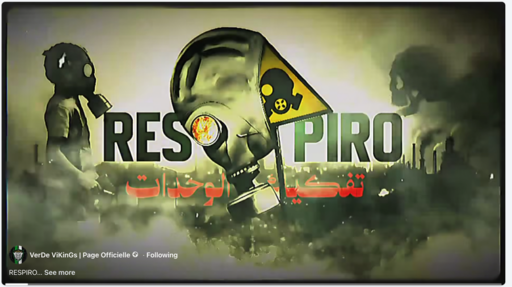
Screenshot from Verde Vikings Facebook page (Verde Vikings, 2025)
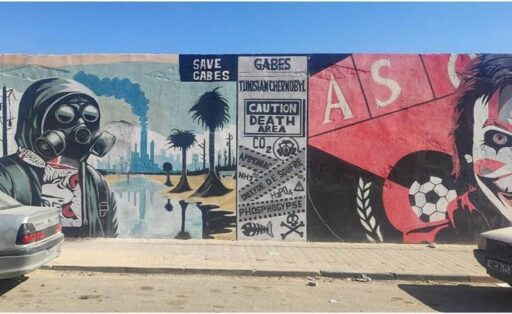
Anti-pollution graffiti by Gabes football Ultras in Gabes, Tunisia, February 2025 (Photo by Dhouha Djerbi)
The Gabes environmental movement thus encapsulates two key trends in the reconfiguration of political participation in an increasingly authoritarian Tunisia. While traditional forms of street-based contentious collective action continue and are witnessing a resurgence, they overlap with a broader ecology of alternative participation interfaces, where a range of actors articulate grievances, mobilise publics, and make demands. In a context of institutional distrust, political exclusion, and widespread repression of dissent, political participation is not disappearing but being reconfigured through culturally embedded, spatially situated, and affectively charged practices outside formal institutions.
References
Addezio, N. (2026, February 4). Gabès Is Suffocating: Breathing Under Phosphate, Protest, and Green Colonialism. Untold Mag. https://untoldmag.org/gabes-tunisia-polution-protest/
Djerbi, D. (2025, November 13). “We Want to Breathe”—Dispatch from Gabes, Tunisia. Middle East Research and Information Project. https://www.merip.org/2025/11/we-want-to-breathe-dispatch-from-gabes-tunisia/
FTDES (Forum Tunisien des Droits Economiques et Sociales). Monthly Reports 2021. Tunisian Social Observatory. https://ftdes.net/en/observatory/
FTDES (Forum Tunisien des Droits Economiques et Sociales). Monthly Reports 2022. Tunisian Social Observatory. https://ftdes.net/en/observatory/
FTDES (Forum Tunisien des Droits Economiques et Sociales). Monthly Reports 2023. Tunisian Social Observatory. https://ftdes.net/en/observatory/
FTDES (Forum Tunisien des Droits Economiques et Sociales). Monthly Reports 2024. Tunisian Social Observatory. https://ftdes.net/en/observatory/
FTDES (Forum Tunisien des Droits Economiques et Sociales). Monthly Reports 2025. Tunisian Social Observatory. https://ftdes.net/en/observatory/
FTDES (Forum Tunisien des Droits Economiques et Sociales). January Monthly Report. Tunisian Social Observatory. 2026, available at: https://ftdes.net/en/observatory/
Gabsi, Z. (2025). Digital mediascapes and cultural transformation: youth identity formation in Tunisia’s post-revolutionary digital sphere. Continuum, 1–19. https://doi.org/10.1080/10304312.2025.2574645
Gandhi, J. (2008). Political institutions under dictatorship. Cambridge University Press.
International Parliamentary Union, Tunisia Assembly of People’s Representatives December 2022 Election (2022). IPU Parline: Global Data on National Parliaments. https://data.ipu.org/parliament/TN/TN-LC01/election/TN-LC01-E20221217/
Jaballah, S. (2026, February 20). Living, Breathing, Resisting: Gabès and the New Political Landscape in Tunisia. Arab Reform Initiative. https://www.arab-reform.net/publication/living-breathing-resisting-gabes-and-the-new-political-landscape-in-tunisia/
Jahmi, C. (2026, March 10). Ultras in Tunisia: stadiums as a space for resistance. Nawaat. https://nawaat.org/2025/07/10/ultras-in-tunisia-stadiums-as-a-space-for-resistance/
Ben Hamadi, M. (2025, October 22). Surge in Tunisia poisoning cases shakes Kais Saied’s presidency. Le Monde. https://www.lemonde.fr/en/le-monde-africa/article/2025/10/22/surge-in-tunisia-poisoning-cases-shakes-kais-saied-s-presidency_6746669_124.html
Magaloni, B. (2006). Voting For Autocracy: Hegemonic Party Survival and Its Demise in Mexico. Cambridge University Press.
Amara, T. (2025, December 17). Tunisians revive protests in Gabes over pollution from state chemical plant. Reuters. https://www.reuters.com/world/tunisians-revive-protests-gabes-over-pollution-state-chemical-plant-2025-12-17/
Ridge, H. M. (2022). Dismantling new democracies: The case of Tunisia. Democratization, 29(8), 1-18. https://doi.org/10.1080/13510347.2022.2093346
Sadiki, L., & Saleh, L. (2024). Seeing Tunisia’s civil society during un-civil times. Instituto Affari Internazionali. https://www.iai.it/sites/default/files/iaip2408.pdf
ICJ. (2025, June 8). Tunisia must quash guilty verdicts against anti-pollution protesters and investigate alleged torture of human rights activist. International Commission of Jurists. https://www.icj.org/tunisia-must-quash-guilty-verdicts-against-anti-pollution-protesters-and-investigate-alleged-torture-of-human-rights-activist/
Verde Vikings Official Page. (2025, October 21). RESPIRO [Facebook page]. Facebook. Retrieved 28 March 2026 from https://www.facebook.com/reel/789873214035927
Weilandt, R. (2025). A series of unfortunate events: the Covid-19 crisis and Tunisia’s democratic backsliding. Contemporary Politics, 1–19. https://doi.org/10.1080/13569775.2025.2502276
Authors: Dr. Tasnim Chirchi & Dr. Intissar Kherigi


Copyrights © 2026 | INTERFACED Cookie & Privacy Policy - Authoritarianism, Political Participation, Trends, Tunisia Webdesign & Development by ALYS